About regional advisory committees
National Parks and Wildlife Service (NPWS) regional advisory committees are community members and stakeholders who provide advice to the Minister for the Environment, the Secretary of the Department of Climate Change, Energy, the Environment and Water, and the National Parks and Wildlife Advisory Council on policies, plans and activities for their region.
Regional advisory committees have a statutory responsibility to provide advice to the Minister on reserve plans of management.
Members are appointed by the Minister under the National Parks and Wildlife Act 1974.
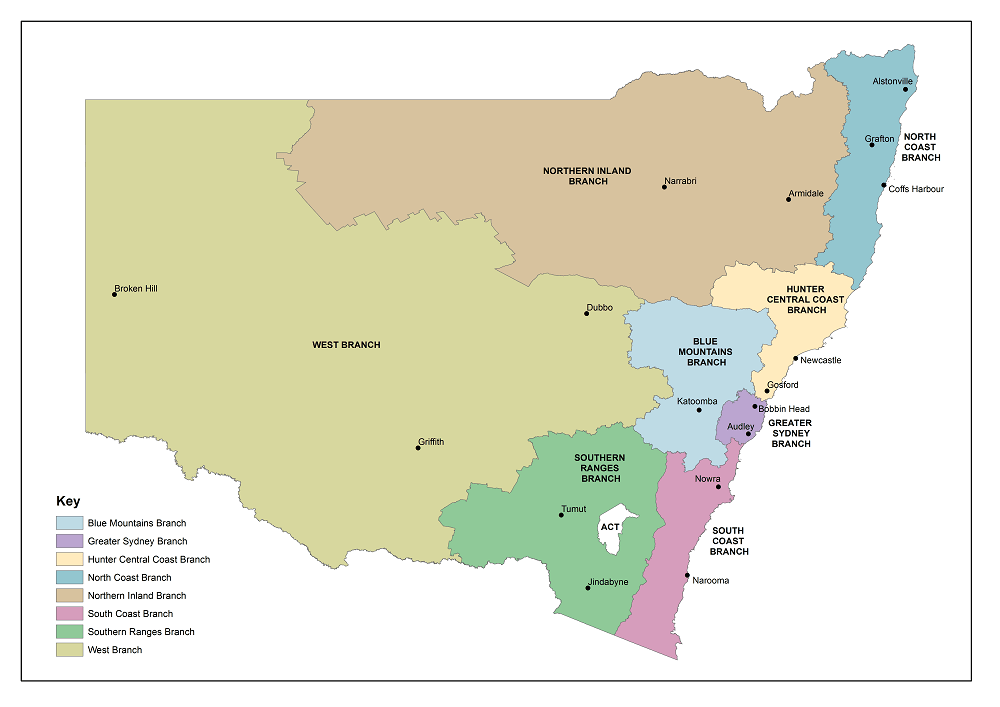
There are 8 NPWS regional advisory committees, one for each of the operational branches.
Who they are
Each regional advisory committee has between 12 and 17 members, including:
- at least 2 Aboriginal people
- a person jointly nominated by the National Parks Association of NSW and the Nature Conservation Council of NSW
- members with expertise in fields such as conservation, environment, recreation, education, cultural heritage and world heritage.
Regional advisory committees are appointed for a 4-year term.
What they do
Regional advisory committees meet at least 4 times a year, including online and at in-person meetings and site visits. Members collaborate with other members, Aboriginal custodians, NPWS staff and management to provide advice on park management. Members provide their informed personal views and represent the views of their aligned organisation or special interest groups.
Issues can include draft plans of management, feral animal and weed plans, fire management, heritage protection and recreation planning.
Members liaise with community and interest groups to bring local views to their committee and NPWS. They provide informed feedback to the community about NPWS initiatives.
Regions and current members
See the regional advisory committee links below for detailed boundary maps:
- Blue Mountains (PDF 883KB)
- Greater Sydney (PDF 729KB)
- Hunter Central Coast (PDF 745KB)
- North Coast (PDF 708KB)
- Northern Inland (PDF 742KB)
- South Coast (PDF 709KB)
- Southern Ranges (PDF 783KB)
- West (PDF 832KB).
Current regional advisory committee members were appointed in July 2022 for a 4-year term.
Email [email protected] for more information on the Blue Mountains Regional Advisory Committee.
Committee members
- Mr Gregory Chapman
- Mr Richard Delaney
- Mr William (Bill) Dixon (Chairperson)
- Ms Nina Gallo
- Ms Cara George (Deputy Chairperson)
- Mrs Sharyn Halls
- Mr Adam Hawken
- Ms Althea Kannane
- Ms Madi Maclean
- Mr Andy Macqueen
- Mr Craig Martin
- Ms Fiona Meller
- Ms Heidi Ploeg
- Mr Trevor Woolley
Email [email protected] for more information on the Greater Sydney Regional Advisory Committee.
Committee members
- Mr Alex Allchin (Deputy Chairperson)
- Ms Sherrie Anderson
- Mr Rob Brewster
- Mr Robert Conroy
- Mrs Kathryn Cox
- Dr Kirsten Crosby
- Ms Kumkum Dubey
- Mr Darren Duncan
- Mr Brian Everingham (Chairperson)
- Mrs Rhonda Lenardon
- Mr Paul Lidgard
- Mr Luke Murtas
- Assoc Prof Julie Old
- Mr Samuel Swain
- Mr Allan Teale
Email [email protected] for more information on the Hunter Central Coast Regional Advisory Committee.
Committee members
- Ms Cassie Bremner
- Mr Art Brown
- Ms Kendal Caynes
- Mr Kevin Duncan
- Ms Jane Frances (Chairperson)
- Mrs Janene Hamilton
- Ms Jessica Leck
- Dr Elizabeth McEntyre
- Ms Suzanne (Sue) Olsson
- Miss Arielle Saunders (Deputy Chairperson)
- Mr Christopher Sheed OAM
- Mr Andrew Smith
- Prof Mark Sutherland
- Mr Chris Tola
- Mr Joe Townsend
Email [email protected] for more information on the North Coast Regional Advisory Committee.
Committee members
- Dr Rosemary Black
- Dr Christopher Carr
- Dr Grahame Douglas
- Mr Stephen (Steve) Fuller
- Ms Karen Love
- Ms Jeanette (Jan) Olley
- Ms Sandra (Sandy) Pimm
- Dr Romina Rader
- Mrs Rhonda (Anjilkurri) Radley
- Dr Adam Smith
- Ms Kim Stephan
- Mr Brett Tibbett
- Mr Peter West
Email [email protected] for more information on the Northern Inland Regional Advisory Committee.
Committee members
- Prof Jeremy Bruhl
- Mr Michael Davis
- Ms Wendy Hawes
- Mr Bryan Johnston (Chairperson)
- Mr Graham Lightbody
- Mr Lancelot (Peter) Lloyd
- Mr Timothy Norton
- Mrs Sally Osland
- Mrs Karen Potter
- Mr James Rainger
- Mr Graham Sawtell
- Mr Peter Shinton
- Mr Simon Smith
- Mr Jason Wilson
Email [email protected] for more information on the South Coast Regional Advisory Committee.
Committee members
- Mr Julian Armstrong
- Prof William Buttemer
- Mr Grahame Byron
- Dr Penny Davidson
- Mrs Lynette Goodwin
- Dr Meredith Henderson
- Ms Jane Madden
- Mr Michael McGrath
- Dr Kevin Mills (Chairperson)
- Ms Paula Pollock
- Mrs Jacqueline Puckeridge (Deputy Chairperson)
- Mrs Julia Short
- Mr Mark Stubbings
- Mrs Yvonne Thomson
Email [email protected] for more information on the Southern Ranges Regional Advisory Committee.
Committee members
- Dr Phillip Andrew
- Ms Stefanie Bonat
- Miss Suzanne Bulger
- Ms Rachel Clarke
- Dr Tracey Dickson
- Ms Megan Graham
- Mr Christopher Griffiths
- Mr Alistair Grinbergs
- Ms Linda Groom
- Mr Peter Hill
- Mrs Ursula Lang
- Mrs Felicity Anderson (Deputy Chairperson)
- Ms Ant Packer
- Mr Ian Pulsford
- Mr Ted Rowley (Chairperson)
- Ms Dianne Thompson OAM
- Dr Frank Ingwersen
Email [email protected] for more information on the West Regional Advisory Committee.
Committee members
- Dr Michael Augee
- Mr Lynton Auld
- Ms Nicola Chandler
- Mr Geoff Chapman (Chairperson)
- Mr Adrian Davey
- Mr Lachlan Gall
- Mrs Diana Hoffman
- Dr Jonathon Howard
- Ms Dianne Kelly
- Ms Yvette Myhill
- Mrs Karen Potter
- Mrs Michelle Pryse Jones
- Mr Bruce Reynolds
- Mrs Marie Russell AM (Deputy Chairperson)
- Mr James Williams
Apply now for 2026
Applications are now open for the new 4-year term of regional advisory committees: 1 July 2026 to 30 June 2030.
Applications close on Wednesday 25 February 2026 at 11:55 pm.
Up to 17 members are sought for each of the 8 NPWS field branches: West, Northern Inland, Blue Mountains, Southern Ranges, North Coast, Hunter Central Coast, Greater Sydney and South Coast.
Members are eligible for sitting fees in accordance with the Classification and Remuneration Framework for NSW Government Boards and Committees (PDF 10.1MB). In addition, NPWS meets reasonable transport costs associated with meetings and field trips.
How to apply
Apply at I Work for NSW.
The application will take around 20 minutes to complete. You will need to upload a CV and any other documentation supporting your application.
Aboriginal people, people from culturally and linguistically diverse communities, young people and people with a disability are encouraged to apply.
What’s involved
RACs meet at least 4 times a year, including online and in-person meetings and field trips. Additional out-of-session reading time is also required in preparation for meetings. Examples of issues considered by RACs include:
- draft plans of management
- proposed additions to parks and new parks
- park infrastructure works, including new and existing visitor precincts
- pest management programs
- fire management
- recreation and tourism planning.
The Board and Committee Code of Conduct (PDF 335KB) sets out the standards of behaviour expected of RAC members. It is the personal responsibility of each committee member to comply with this code, which is underpinned by NSW Government’s core values of integrity, trust, service and accountability.
Why join a regional advisory committee?
Regional advisory committees are diverse groups who come together to discuss, advocate and advise on local park planning and management issues, bringing their skills and experience to work directly with park managers on key challenges.
Current members were asked about the rewarding aspects of being on a regional advisory committee:
‘The privilege ... to make a difference by representing community [and] adjoining neighbours and passing advice to management and government to make a difference.’
‘Members’ input, advice, opinions, reviewing plans of management are valued and respected, especially where community and neighbours are concerned.'
‘Site visits and discussion time between staff and member leads to a good balance and clearer understanding of the management issues.’
‘Opportunities to explore issues from a wide range of experiences and backgrounds.’
‘Acting as a liaison between the [regional advisory committee] and community members to facilitate conflict resolution.’
‘Engagement with passionate local staff, board members, traditional owners and other [regional advisory committee] members.’
‘I feel my contribution is appreciated and everyone is respected. I think it is valuable to support the work of the NPWS.’